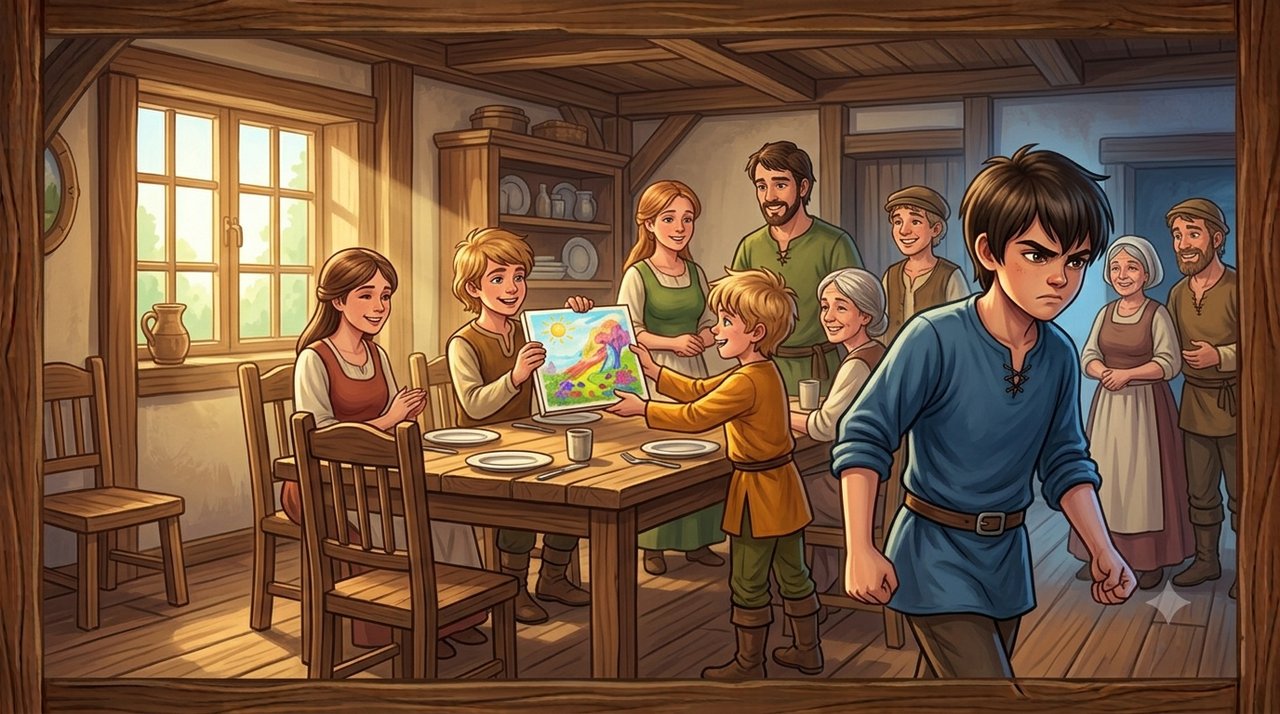
In Tal-Or, the village of craftsmen, ringed by green wheat fields and workshops, there lived a diligent and sensitive boy named Itamar. Itamar carved wood with wonderful precision, but a quiet heaviness always stirred in his heart: his younger brother, Yonatan, had a gift for vivid painting and a winning smile that drew people to him easily. Every time Yonatan was given attention, a compliment or a prize, Itamar could not see the success for what it was – it felt to him like final proof that he himself was worth less.
The warped mechanism: measuring your worth by another's success
Itamar built himself a filter that let only the bad through, and a habit of wounding comparison, so that every happy moment in the house read as a direct threat to his place:
Yonatan shows a new painting on a Friday evening and the family praises it – and Itamar hears only one thing: "They are all admiring him because nobody cares about my carving." And so: a scornful laugh, a barbed remark about "imprecise lines", and leaving the table in anger.
His parents buy Yonatan a new set of brushes for his birthday – and Itamar concludes: "They invest only in him and see only what he needs." And so: a furious silence, a bedroom door shut, and his parents accused of unfairness and favouritism.
Yonatan asks Itamar's advice on carving a frame for a painting – and Itamar reads a thought that was never there: "He is only trying to look down on me and show that he can do my work too." And so: an aggressive refusal – "Manage on your own, and don't touch my materials!"
The crisis and the collapse of the fortress
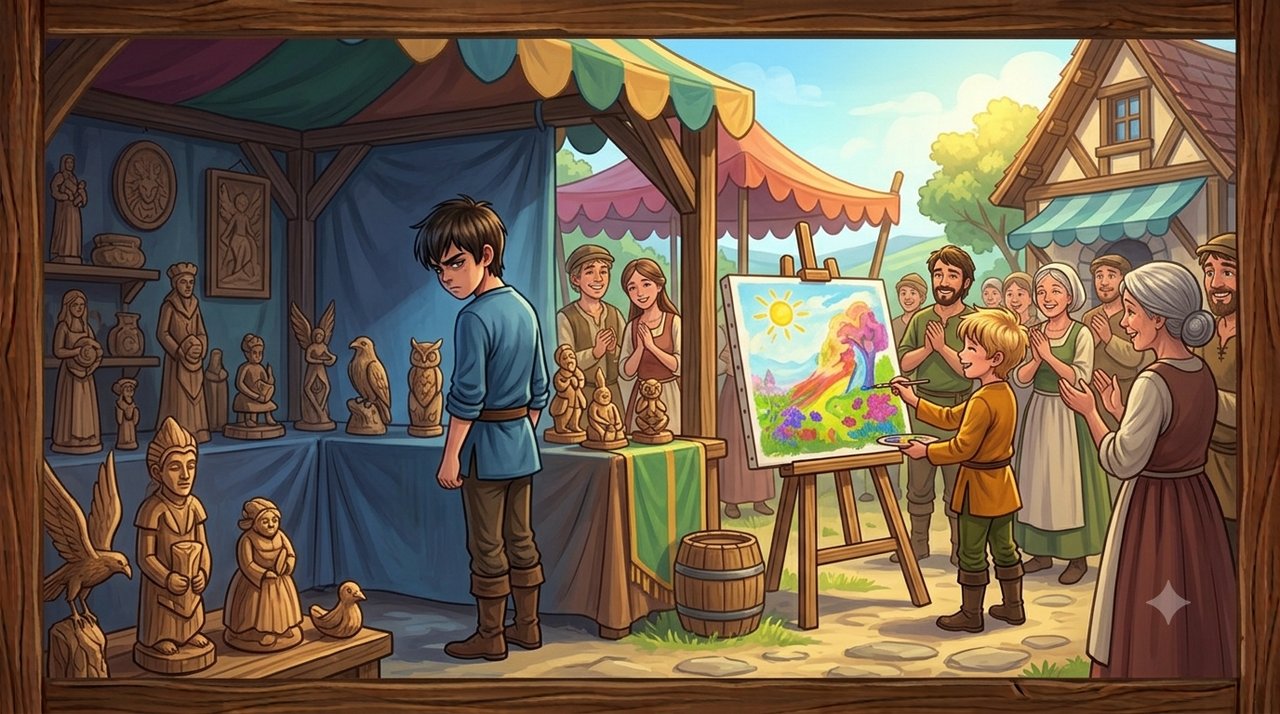
As the village's yearly spring fair approached, both brothers were invited to show their work in the shared family stall. When Itamar saw that Yonatan had finished a magnificent landscape that was drawing the eyes of half the village, his envy turned into a choking burn. On an impulse he could not master, Itamar hid his brother's painting behind some old wooden crates so that nobody would notice it.
When it was discovered, the stall did not fill with the storm of a quarrel as Itamar had expected, but with a heavy, painful quiet. Yonatan looked at him with tears in his eyes and could not understand why his older brother, the one he had modelled himself on, would wish him harm. Their parents stood there helpless, and Itamar found himself alone in an abandoned stall. His carvings were perfect and polished, but nobody was glad to stand beside him. The loneliness was cold and heavier than he could carry.
The meeting with the wise man, and the spectacles
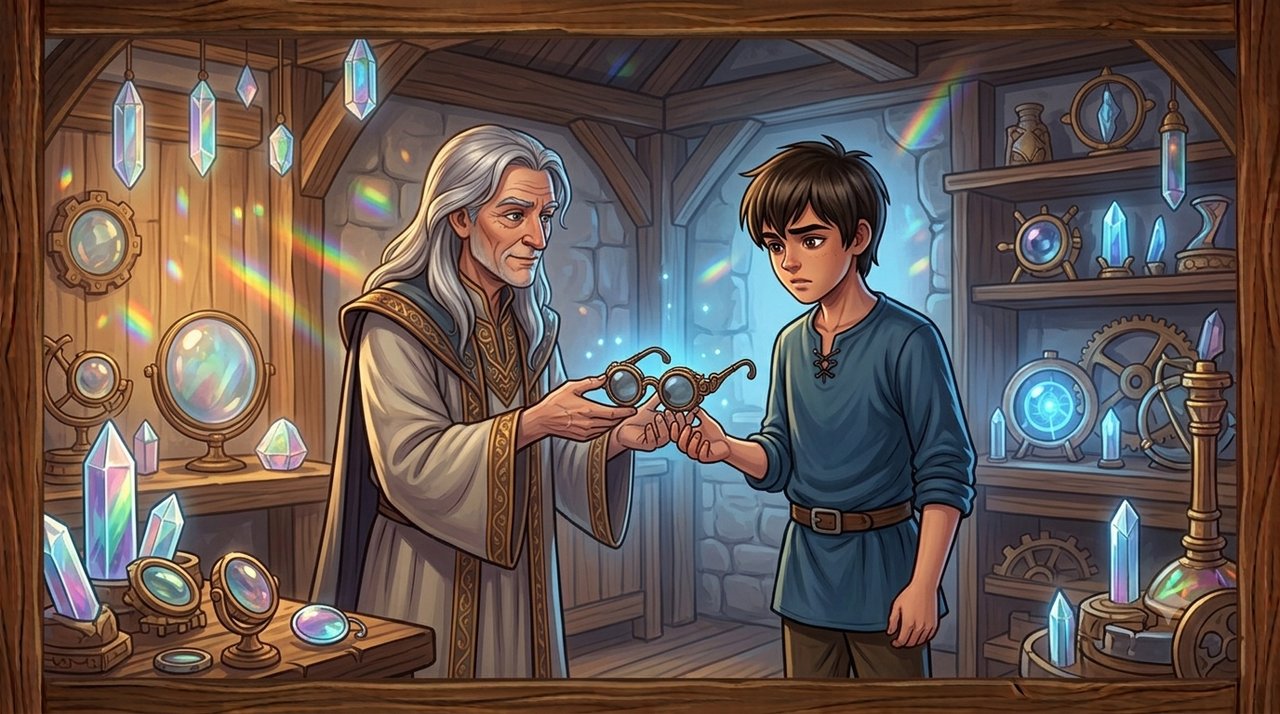
Itamar fled to the edge of the village, to the mirror workshop of Elkana, the eldest of the craftsmen. Elkana looked at the distraught boy, did not scold him and did not judge him, but drew from an old leather bag a pair of shadowed spectacles with clouded lenses.
"Put them on, Itamar," Elkana said gently.
Itamar put on the spectacles and looked around him. Every lit object in the workshop suddenly seemed grey, while the dark shadows loomed enormous and menacing. When Elkana set a glittering precious stone in front of him, through those lenses the stone looked like a worthless lump of coal.
"These are the spectacles of envy," Elkana explained. "They make you believe that another person's light casts a shadow that darkens you. While you wore them, every compliment Yonatan received looked to you like your own light being stolen. But see what happens when you take them off."
Itamar took off the spectacles. The light in the workshop shone again, and the glittering stone went back to sparkling in all its beauty without taking anything from the beauty of a single other object in the room.
"Yonatan's talent and Yonatan's light take nothing from you," Elkana added. "The world is not a limited store of appreciation. There is room in the sky for all the stars to shine together without hiding one another."
Understanding, and repair
The words opened Itamar's eyes. For the first time he saw how envy had made him bend reality, and read a rivalry that was never there into his brother's outstretched hand.
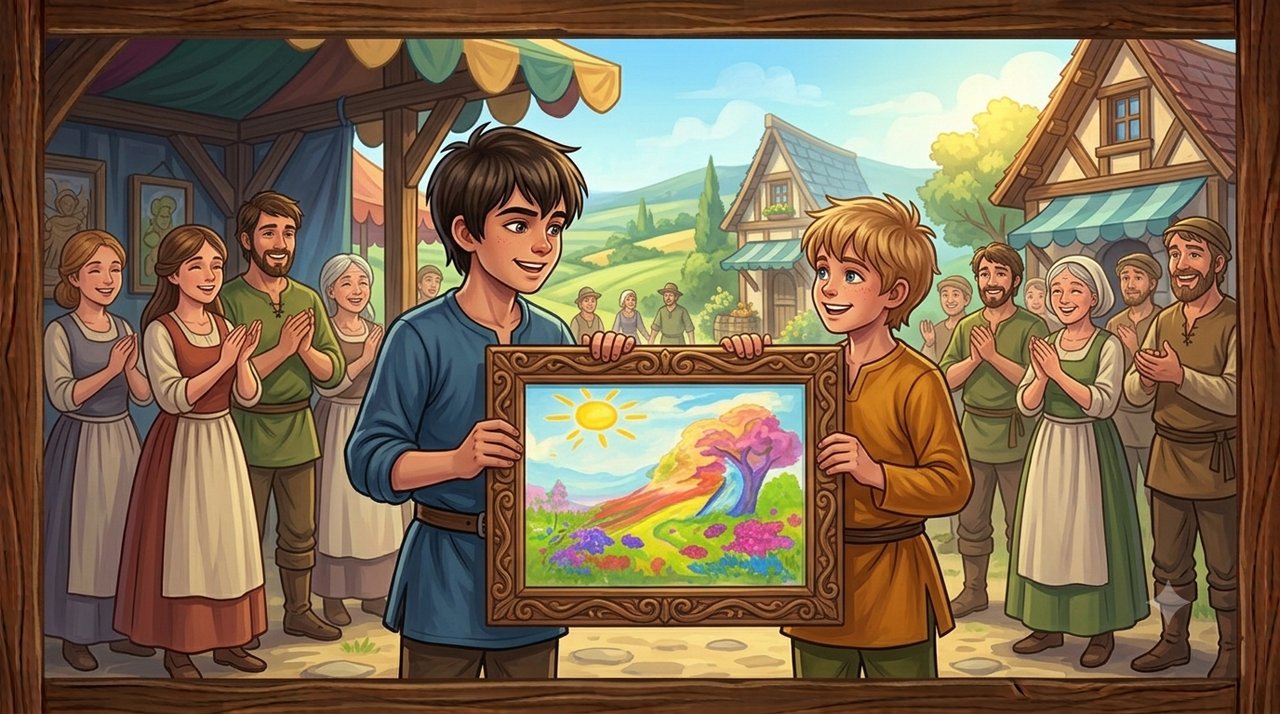
Itamar ran back to the fair. He went to the wooden crates, carefully lifted out Yonatan's painting, and set it in the middle of the stall beside his own carving. Looking at his younger brother, he said in a steady, clear-eyed voice: "Your painting is beautiful, Yonatan. I was wrong to think your success made me smaller. Forgive me. Both of us deserve to stand here together."
The two of them joined their work: Itamar carved a fine wooden frame that surrounded Yonatan's painting and set it off, and the family stall became one whole space of beauty and partnership.
Envy is a pair of warped spectacles that makes us think another person's success comes at our expense. Once we understand that the world is wide enough for every person's gift, we find that a brother's light does not put ours in shadow – it shines together with ours.